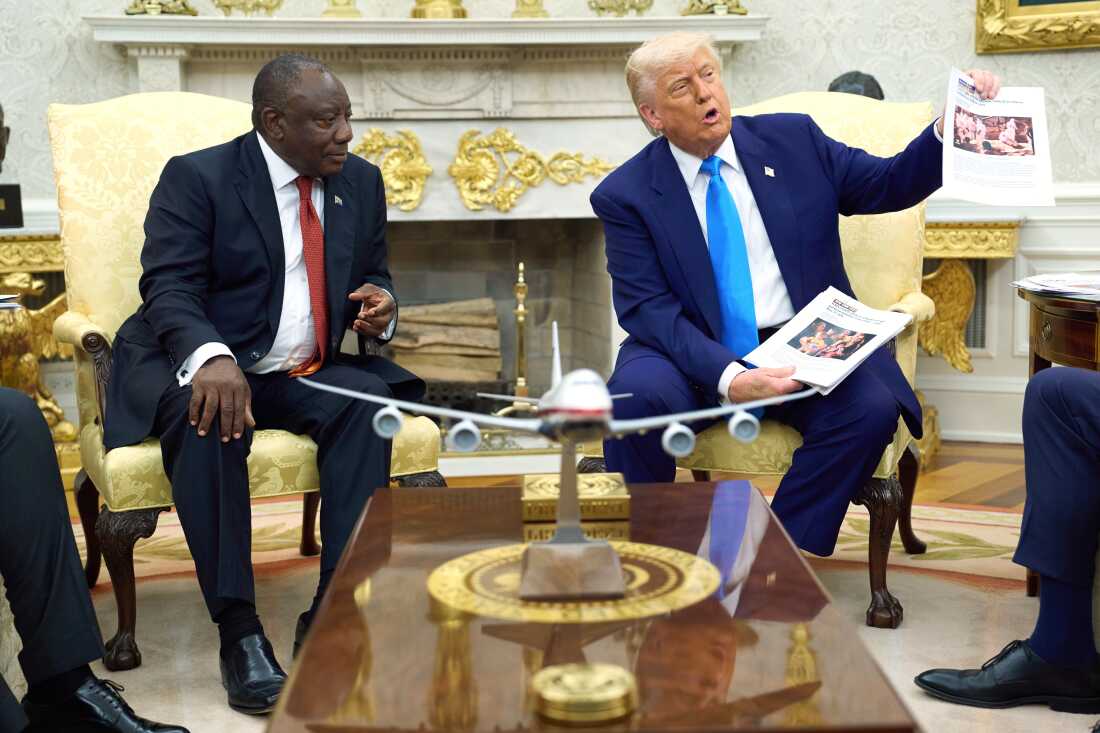
On 21 May 2025, the dignity that Nelson Mandela, Oliver Tambo, and Walter Sisulu fought so valiantly to secure for a democratic South Africa was dealt a symbolic blow in Washington, D.C., at the White House. What was meant to be a diplomatic meeting between South African President Cyril Ramaphosa and U.S. President Donald Trump quickly devolved into a theatre of disrespect, racial overtones, and power imbalance, raising critical questions about leadership, representation, and the legacy of the anti-apartheid struggle.
President Ramaphosa had maintained that the visit was primarily focused on bilateral trade relations and strengthening diplomatic ties. However, what unfolded before a sea of flashing cameras was anything but an equal partnership in dialogue.
The setting resembled a school principal rebuking students, rather than a meeting of two heads of state.
Trump commandeered the conversation, dominating the room while Ramaphosa’s delegation, ironically composed primarily of white South Africans, was selectively given a chance to speak. Most notably, the Black Labour Minister, Nomakhosazana Meth, was visibly overlooked until Ramaphosa intervened to grant her a voice. That moment, brief as it was, starkly exposed the racial dynamics that still permeate spaces where power is negotiated, even in the post-apartheid context.
It begs the question: why were individuals with no governmental roles, many of whom were white Afrikaners, part of the South African delegation at all?
Was their presence meant to curry favour with Trump’s conservative base, or were they there as a moral cushion to mask an administration that increasingly appears distant from the aspirations of the ordinary South African? If these individuals were meant to represent the ‘new’ South Africa, their selection sends a chilling message: that whiteness remains the default face of diplomacy when validation from the West is being sought.
The encounter took an even more troubling turn when Trump unveiled a series of printed documents and video clips, uncited and undated, alleging genocide in South Africa. The material, pulled out like evidence in a courtroom ambush, echoed fa
Despite this provocation, Ramaphosa maintained composure, his demeanour dignified but almost too restrained in the face of blatant disrespect, not just to him, but to South Africa as a sovereign nation.
That restraint, though admirable, leads us to imagine how the meeting might have unfolded under different leadership. One wonders how Nelson Mandela, with his indomitable moral authority, would have handled Trump’s dismissiveness. Would Thabo Mbeki’s sharp intellect and diplomatic finesse have reframed the discourse more assertively? Would Julius Malema have remained silent as a U.S. President sidestepped Black South African voices? What of Steve Biko’s defiant clarity or Burkina Faso’s Ibrahim Traoré, who has been unapologetic in asserting African dignity on global platforms?
Even more revealing were the post-meeting disclosures. Democratic Alliance (DA) leader John Steenhuisen candidly admitted that the DA’s participation in the Government of National Unity (GNU) was less about cooperation and more about exclusion—specifically keeping the MK Party and the Economic Freedom Fighters (EFF) from accessing state power. This tactical alliance calls into question whether the GNU is a vehicle for unity or simply a mechanism for gatekeeping.
The opti, they were symbolic of a deeper erosion of post-liberation values. South Africa, the economic powerhouse of Africa, deserves better than a cameo in a U.S.-centric narrative where its president is treated as a subordinate.
As the African continent reflects on its path forward, we must remember that dignity is not negotiable. The freedom Mandela and his comrades fought for included the right to be respected as equals on the global stage. It is time to reassess not just who leads, but whose voices are elevated when South Africa speaks for itself abroad.