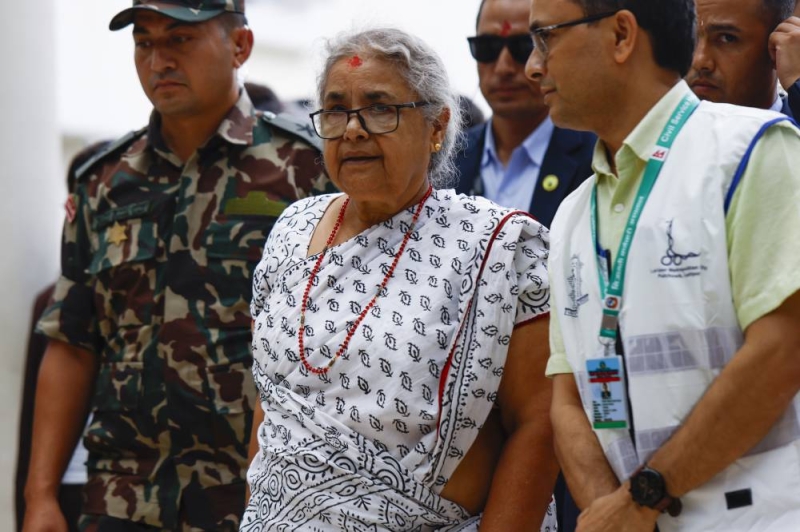
In an era when many youth movements are dismissed as leaderless or chaotic, Nepal’s Generation Z has demonstrated that organization, transparency, and digital literacy can redefine political participation. Their bold experiment, electing an interim prime minister via Discord, has not only energized their movement but also offered a compelling counterpoint to how other uprisings have faltered. In doing so, Nepal’s Gen Z has shown the world that the tools of the gaming generation can also be the tools of democratic renewal.
Discord offered voice channels for debate, polling functions for decision-making, and text channels for manifestos, policy proposals, and Q&A sessions with candidates.
A Digital Assembly Line for Democracy
At the heart of Nepal’s Gen Z revolution was a simple yet radical idea: leadership must be earned through transparent, participatory processes, not imposed or assumed. Rather than relying on informal cliques or opaque negotiations, they adopted Discord, the same platform teenagers use to coordinate gaming raids and study groups, as a formalized election and deliberation space.
Discord offered voice channels for debate, polling functions for decision-making, and text channels for manifestos, policy proposals, and Q&A sessions with candidates. This structure allowed thousands of young Nepalese citizens to participate simultaneously in discussions about leadership, priorities, and tactics. Sushila Karki’s rise to interim prime minister was not the result of backroom deals but of thousands of verified votes, live-streamed debates, and transparent tallies visible to all.
Electing Sushila Karki: A Transparent Experiment
The election itself unfolded over several carefully staged phases. First, candidates were nominated in open forums, where their credentials and visions for Nepal’s future were scrutinized by peers. Next came structured debates, moderated by volunteers who enforced time limits and civility rules. Polls were conducted using Discord’s built-in reaction-voting and third-party bots designed to prevent duplicate voting.
When the final vote was tallied, Karki, Nepal’s former Chief Justice and widely respected for her public service and integrity, emerged as the consensus choice. This was not because of traditional party machinery but because of her ability to articulate Gen Z priorities and her proven track record in public service. Crucially, every step of this process was archived, allowing for post-election auditing and creating a level of legitimacy rarely seen in youth-led uprisings.
Lessons for Egypt, Sudan, and Kenya: The Missed Formula
Nepal’s digital election contrasts sharply with the trajectory of Egypt’s Arab Spring and Sudan’s Gen Z uprisings, and also offers a telling lesson for Kenya’s youth activism. In Egypt, youth activists played a decisive role in mobilizing protests against Hosni Mubarak, but after his ouster, a leadership vacuum emerged. Without a unified, transparent process for selecting leaders or negotiating with entrenched power brokers, the movement fractured, paving the way for a military-backed regime to retake control.
Similarly, Sudan’s Gen Z demonstrators were celebrated for their bravery and decentralised organizing during the 2019 protests. Yet their movement was also undermined by weak leadership structures and infiltration, making it vulnerable to hijacking by political elites and military factions.
Kenya’s 2024–2025 Gen Z protests, driven by frustrations over governance, unemployment, and rising costs of living, have mobilised unprecedented numbers of young people. Yet, despite their scale and energy, these protests have also struggled to convert digital outrage and street mobilization into durable political power. The absence of a transparent, technology-driven system for selecting and legitimizing youth leaders has often led to fragmentation, elite co-option, or loss of momentum once protests subside.
In all three cases, the lack of a clear, collectively chosen leadership meant that revolutionary energy dissipated rather than consolidating into sustainable governance, a pitfall Nepal’s Gen Z has deliberately avoided.
Why Nepal’s Model Works
By contrast, Nepal’s Discord election model solved three chronic problems of youth uprisings:
- Leader Legitimacy – A publicly elected leader gains instant legitimacy, minimizing internal dissent.
- Transparency – Open debates and visible vote counts reduce suspicions of manipulation.
- Scalability – Digital platforms allow rapid scaling beyond traditional activist networks.
Rather than privileging those with existing institutional power or media access, this model rewards persuasive ideas, coalition-building, and grassroots credibility. Karki’s election thus represents not just a personnel change but a paradigm shift: power flowing upward from the crowd, not downward from elites.
The Future of Digital Democracy
The implications are far-reaching. If a youth-led movement in Nepal can hold a credible election on Discord, what stops climate activists in Europe, pro-democracy students in Asia, or grassroots organizations in Africa from doing the same? Such platforms could democratize candidate selection in ways that traditional political parties have long resisted.
Of course, challenges remain. Digital elections must address cybersecurity, bot manipulation, and the digital divide. They must also translate online legitimacy into offline power, a feat Nepal’s Gen Z will still have to prove. But the precedent is clear: in a hyperconnected age, movements that embrace transparent digital governance will outlast those that cling to opaque hierarchies.
A Blueprint for the World’s Youth
Nepal’s Generation Z has not just toppled old assumptions about youth movements; they have prototyped a model of participatory leadership that could define 21st-century activism. By learning from the failures of Egypt, Sudan, and Kenya, where charisma and spontaneity proved insufficient, Nepal’s youth have shown the strength of deliberate, democratic design.
If their experiment succeeds, it could mark a turning point in how grassroots political power is built and sustained. The “Discord model” may one day be as synonymous with democratic innovation as the printing press or the secret ballot. For now, it stands as a testament to the creativity and discipline of a generation determined not only to change their country but also to change the very rules of political engagement worldwide.