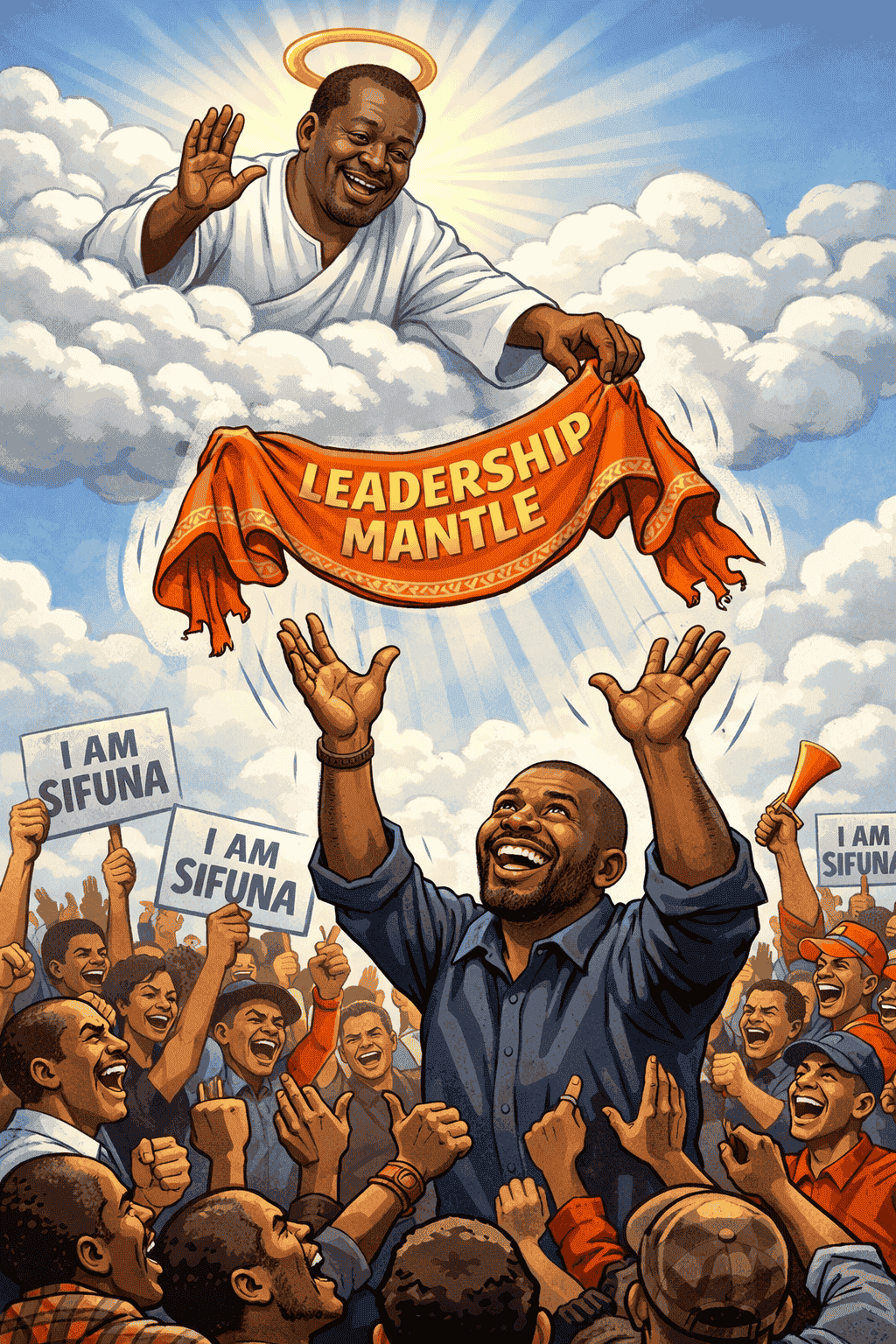
In every political epoch, there emerges a moment when history quietly begins to rearrange its leadership architecture. These moments are rarely announced through official declarations or institutional endorsements. Instead, they reveal themselves in the raw theatre of mass politics, in the cadence of speeches, in the spontaneous roar of crowds, and in the unmistakable psychological transfer of political energy from one gene
in Edwin Sifuna, Kenya may be witnessing not the replacement of Raila Odinga
For decades, the gravitational centre of opposition politics in Kenya has revolved around one towering figure: Raila Odinga. Raila was not merely a politician; he was an institution, a living embodiment of resistance, defiance, and democratic agitation. His political energy was not manufactured in boardrooms; it was forged in the crucible of struggle, detention, and ideological confrontation. That kind of political capital cannot be transferred by decree.
It can only be inherited by demonstration.
What unfolded recently in Kitengela was not an ordinary political rally. It was a signal event, an unmistakable inflection point in Kenya’s opposition political continuum. The rally was explosive not in the narrow sense of spectacle, but in the deeper, more consequential sense of symbolic power consolidation. Thousands gathered not out of obligation, but out of conviction. The atmosphere was electric, saturated with anticipation and emotional investment. The euphoric crowd did not merely attend; they affirmed. They did not merely listen; they entrusted.
This distinction is critical.
Crowds in Kenyan politics are highly discerning instruments of political validation. They possess an instinctive ability to detect authenticity, cour
What they extended to Sifuna in Kitengela was not curiosity, it was recognition.
Equally significant was the presence of senior political figures who stood beside him. Their attendance represented more than procedural solidarity. It signalled institutional acknowledgement. In political ecosystems, legitimacy is often communicated through proximity. Leaders align themselves not merely with individuals, but with trajectories. Their presence around Sifuna reflected an implicit understanding: that a new centre of political gravity is emerging within the opposition framework.
At its core, leadership in opposition politics is not about titles. It is about symbolic authority—the ability to embody the collective frustrations, aspirations, and psychological resilience of a political base. This was Raila Odinga’s defining strength. He did not command loyalty through position; he commanded it through presence.
Edwin Sifuna is now demonstrating that same rare capacity.
His political posture reflects a striking continuity with the Odinga tradition. His rhetoric is firm but measured. His defiance is calibrated, not reckless. His confidence is neither theatrical nor tentative, it is anchored in ideological clarity. Most importantly, he has shown a willingness to occupy political space unapologetically, even in the face of institutional resistance.
This is the crucible through which authentic opposition leaders are forged.
What makes Sifuna’s emergence particularly consequential is its organic nature. He is not the product of political inheritance in the conventional sense. He has not been installed through elite consensus or manufactured through media engineering. Instead, his ascent is rooted in political engagement, institutional confrontation, and public persuasion. This pathway confers a form of legitimacy that cannot be artificially replicated.
The psychological dimension of his rise cannot be overstated. Opposition politics is sustained as much by emotional energy as by structural organization. When that emotional energy dissipates, movements stagnate. When it is reignited, movements become unstoppable. What Sifuna demonstrated in Kitengela was his ability to reactivate that dormant energy—to remind opposition supporters of their collective agency.
This is precisely what Raila Odinga represented at his political zenith.
The parallels are neither superficial nor coincidental. Like Raila, Sifuna projects ideological conviction rather than opportunistic flexibility. Like Raila, he appears comfortable in confrontation. And like Raila, he commands attention not through coercion, but through resonance.
Political succession within liberation-style movements rarely follows formalized scripts. It occurs through a process of symbolic transfer, where the political base gradually begins to see its future reflected in a new figure. This process is already underway.
The scale and intensity of the Kitengela rally served as a real-time referendum on Sifuna’s political viability. Crowd turnout is one of the most reliable indicators of political momentum. It reflects not only popularity, but mobilization capacity, a leader’s ability to convert abstract support into physical presence. By this metric, Sifuna has demonstrated operational capability at a national scale.
His rise also reflects a broader structural reality: political ecosystems abhor vacuums. When an iconic leader transitions into a different phase of political engagement, space inevitably opens. That space does not remain empty. It attracts individuals with the psychological disposition, ideological clarity, and strategic courage to occupy it.
Sifuna is occupying that space decisively.
Within the Orange Democratic Movement and beyond, he is increasingly functioning as a rallying node, a focal point around which opposition energy is reorganizing. His ability to command respect across generational and institutional lines signals the consolidation of political authority, not merely its aspiration.
Importantly, leadership legitimacy in Kenyan politics is ultimately conferred by the public, not by party constitutions. It is forged in rallies, tested in adversity, and validated through sustained engagement. The events in Kitengela provided compelling evidence that Sifuna has crossed a critical threshold—from being a political participant to becoming a political standard bearer.
This moment should be understood not as an endpoint, but as an inflection point.
Kenya’s opposition landscape is entering a phase of recalibration. New leadership dynamics are emerging. New centres of influence are crystallizing. And new vessels of political energy are being filled.
Edwin Sifuna’s trajectory suggests that he is no longer merely operating within Raila Odinga’s political shadow. He is beginning to extend that shadow forward—reshaping it, expanding it, and projecting it into the future.
History does not replicate itself mechanically. But it often reincarnates its energy through new actors.
What happened in Kitengela was not just a rally. It was the visible manifestation of political succession in motion. It was the sound of opposition machinery reactivating. It was the unmistakable signal that the torch of political resistance is not being extinguished, it is being carried forward.
And in Edwin Sifuna, Kenya may be witnessing not the replacement of Raila Odinga, but the continuation of his political spirit in a new, formidable form.