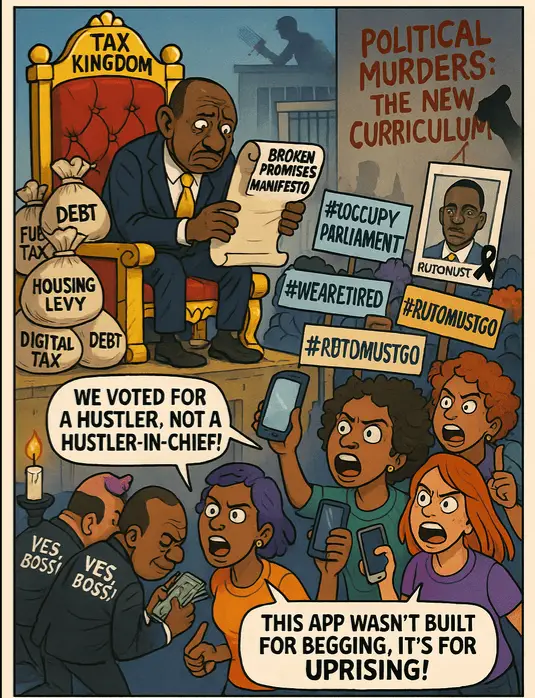
“Hustler-in-Chief,” a man of the people who would champion the poor, create jobs, fight corruption, and reform the country’s economic woes. Two years into his presidency, Kenyans are grappling not with progress, but with betrayal, soaring taxes, and a growing sense of despair. The streets are stirring—and this time, it’s not the opposition leading the charge. It’s Kenya’s Gen Z.
Broken Promises and Unbearable Taxes
President Ruto’s campaign was built on promises of economic justice and bottom-up development. Yet, since taking office, his administration has presided over an economic crunch of historic proportions. A battery of new taxes has been levied, suffocating ordinary Kenyans already burdened by unemployment and inflation. Among the most controversial is the Housing Levy, a mandatory deduction from workers’ paychecks meant to fund an opaque public housing scheme. The Digital Service Tax has hit the youth-dominated gig economy hard, while hikes in fuel taxes have had a domino effect on food and transport prices.
The government has also introduced increased social security contributions, further shrinking disposable incomes. For a population promised relief,
the result has been growing anger and daily survival struggles.
A Silenced Opposition, A Bought Parliament
Ruto’s political maneuvering has not only failed to address citizens’ concerns—it has actively silenced dissent. Key opposition leaders have been neutralized through patronage, with Members of Parliament crossing over to the ruling coalition in suspiciously quick succession. Civil society watchdogs accuse the president of using state resources to buy political loyalty, eroding accountability. Kenya’s Parliament, once a robust forum for public debate, now appears more like a rubber-stamp chamber serving executive interests.
Raila Odinga, has failed to mobilize meaningful resistance,
The official opposition, led by Raila Odinga, has failed to mobilize meaningful resistance, leaving a leadership vacuum, one that Kenya’s Gen Z has boldly stepped in to fill.
The Gen Z Uprising: A New Political Force
In June 2024, Kenyan youth, many born after the year 2000, launched a series of spontaneous, leaderless protests. Dubbed the #OccupyParliament movement, young people stormed Parliament grounds in Nairobi in an unprecedented show of defiance. Their placards carried no party logos—just raw rage at an economic system they say has locked them out.
The demonstrations were peaceful. Yet, as has become routine in Ruto’s Kenya, state security responded with deadly force. Two protesters were shot dead. Their names have become rallying cries: symbols of resistance and sacrifice. Under Ruto’s leadership, Kenya has seen an alarming rise in political killings of young people, according to human rights groups—marking a dark era in the country’s post-independence history.
The Murder of Albert Ojwang: A Triggering Point
The recent killing of prominent blogger and digital activist Albert Ojwang, known for exposing corruption and documenting youth-led protests, has rekindled national fury. Ojwang was abducted and found dead under suspicious circumstances in early June 2025. Though the state denies involvement, few believe them.
In response, Gen Z activists have called for another mass protest on June 12, 2025. The momentum is palpable—online, on campus, in the streets. What’s different this time is the conviction that change will no longer come through traditional politics but through collective action, digital mobilization, and fearless resistance.
Ruto’s leadership, Kenya has seen an alarming rise in political killings of young people
Can the Youth Topple Ruto?
The idea of toppling a sitting president may have once seemed far-fetched. Today, it is a growing whisper among Kenya’s youth. While no formal political structure backs the Gen Z movement, its power lies in its spontaneity, tech-savviness, and moral clarity. Ruto’s regime has underestimated them—until now.
What remains to be seen is whether this movement can transform street protests into sustained political pressure, or even a new political order. But one thing is certain: Gen Z in Kenya is no longer just tweeting. They are marching, resisting, and demanding a new future. And they may just get it.