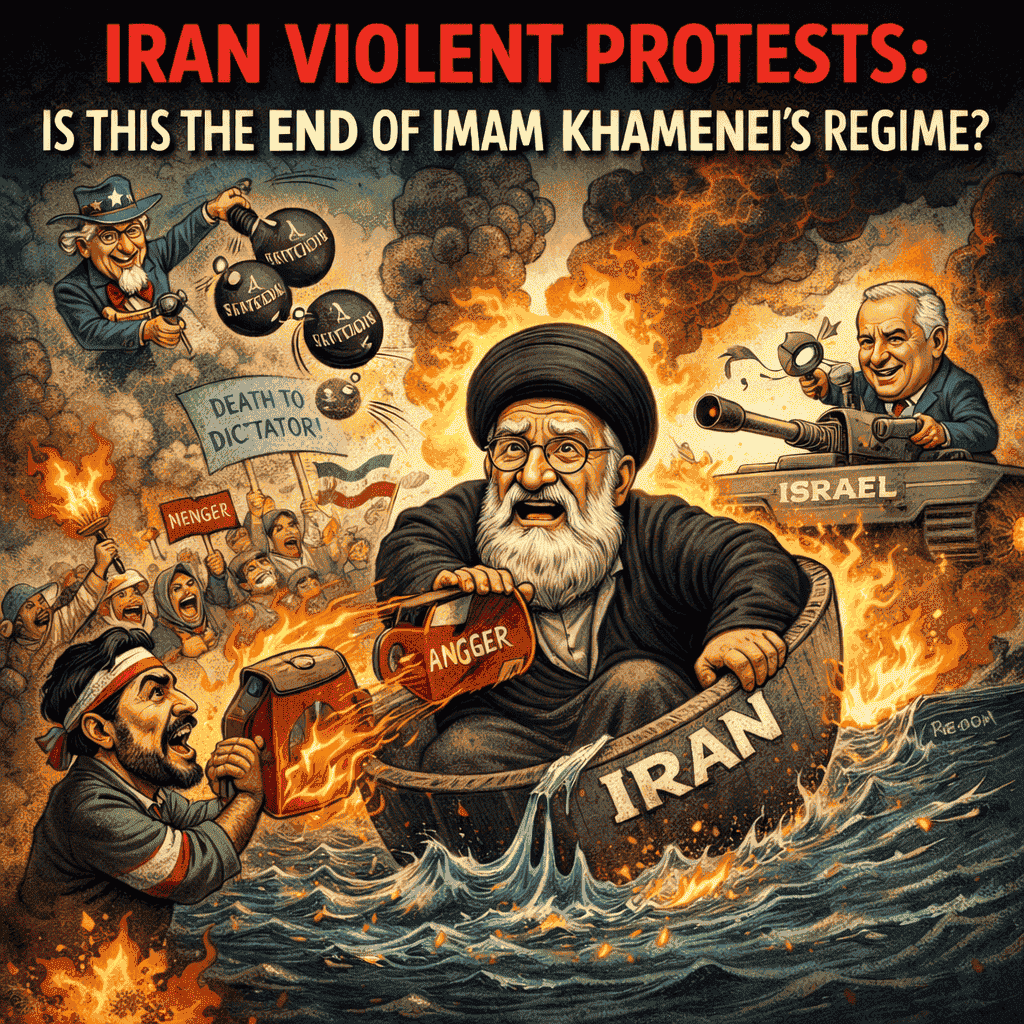
Iran currently occupies a critical position in the regional and global power architecture, functioning as both a Middle Eastern heavyweight and a core pillar of the so-called second axis of global power alongside Russia, China, and North Korea. From a strategic standpoint, Iran’s military capabilities, ideological reach, and network of regional allies have enabled it to effectively contest Israeli dominance and challenge Western influence across the Middle East. However, the country is now facing a convergence of internal and external pressures that threaten to significantly disrupt this positioning and recalibrate the regional balance of power.
the country is now facing a convergence of internal and external pressures
At the domestic level, Iran is experiencing an unprecedented wave of nationwide protests cutting across major urban centres. These protests are not merely episodic expressions of dissent but reflect deep-seated structural vulnerabilities, including economic contraction, currency collapse, high unemployment, and declining living standards. From a governance and risk-management perspective, this signals a serious erosion of state legitimacy and social cohesion. The Iranian population, particularly younger demographics, is increasingly disengaged from the ideological narratives that have historically underpinned regime stability. This creates a volatile operating environment for the current leadership and raises material questions about regime sustainability.
From a geopolitical lens, the potential destabilisation—or collapse—of Iran’s current leadership carries significant downstream implications. Regionally, Iran has long functioned as the strategic backbone of the so-called “axis of resistance,” providing financial, military, and logistical support to actors such as Hezbollah in Lebanon and Hamas in Gaza. A weakened or internally preoccupied Iran would represent a major strategic setback for these groups, significantly reducing their operational capacity and bargaining power. In this scenario, the Palestinians emerge as among the biggest strategic losers, as one of their most consistent state-level backers would be severely constrained or neutralised.
This creates a volatile operating environment for the current leadership and raises material questions about regime sustainability.
At the same time, Israel and the United States would likely view regime instability in Iran as a strategic opportunity. From a realpolitik standpoint, both actors have long prioritised the containment—or outright neutralisation—of Iranian influence. A leadership vacuum, civil conflict, or state fragmentation could open pathways for external actors to shape post-crisis outcomes through political, economic, and covert interventions. However, this is a high-risk, high-uncertainty proposition. Historical precedent from Iraq, Libya, and Afghanistan demonstrates that regime change without robust, locally grounded transition frameworks often results in prolonged instability, proxy conflicts, and governance failure.
The prospect of Iran descending into a failed or semi-failed state represents a worst-case scenario for regional stability. Such an outcome could trigger internal factionalism, ethnic and sectarian fragmentation, and competing centres of power, some of which may be externally sponsored. From a strategic risk assessment perspective, this would not only destabilise Iran internally but also generate significant spillover effects across the Middle East, including refugee flows, arms proliferation, and intensified proxy warfare. Countries such as Jordan and Egypt may initially perceive the weakening of Iran as a strategic gain, but over the medium to long term, the systemic instability generated could undermine broader regional security architectures.
the Palestinians emerge as among the biggest strategic losers,
Globally, Iran’s destabilisation would also weaken the coherence of the second axis of power. While Russia and China may not be ideologically aligned with Tehran, they benefit from Iran’s role as a counterweight to U.S. and Western dominance. A diminished Iran would reduce strategic optionality for this bloc and consolidate Western leverage in key energy corridors and security theatres. This underscores that the Iranian crisis is not merely a domestic issue but a node of global strategic significance.
In summary, Iran stands at a strategic inflection point. The current wave of protests reflects profound internal governance and economic failures, while the potential fallout from leadership collapse carries far-reaching regional and global consequences. Any attempt to capitalise on Iran’s internal instability for short-term geopolitical gain risks producing long-term systemic instability. From a strategic governance perspective, the Iranian case reinforces a critical lesson: sustainable power is not derived solely from military capacity or ideological positioning, but from economic resilience, social legitimacy, and adaptive leadership. Without these, even the most formidable regional powers remain structurally vulnerable.