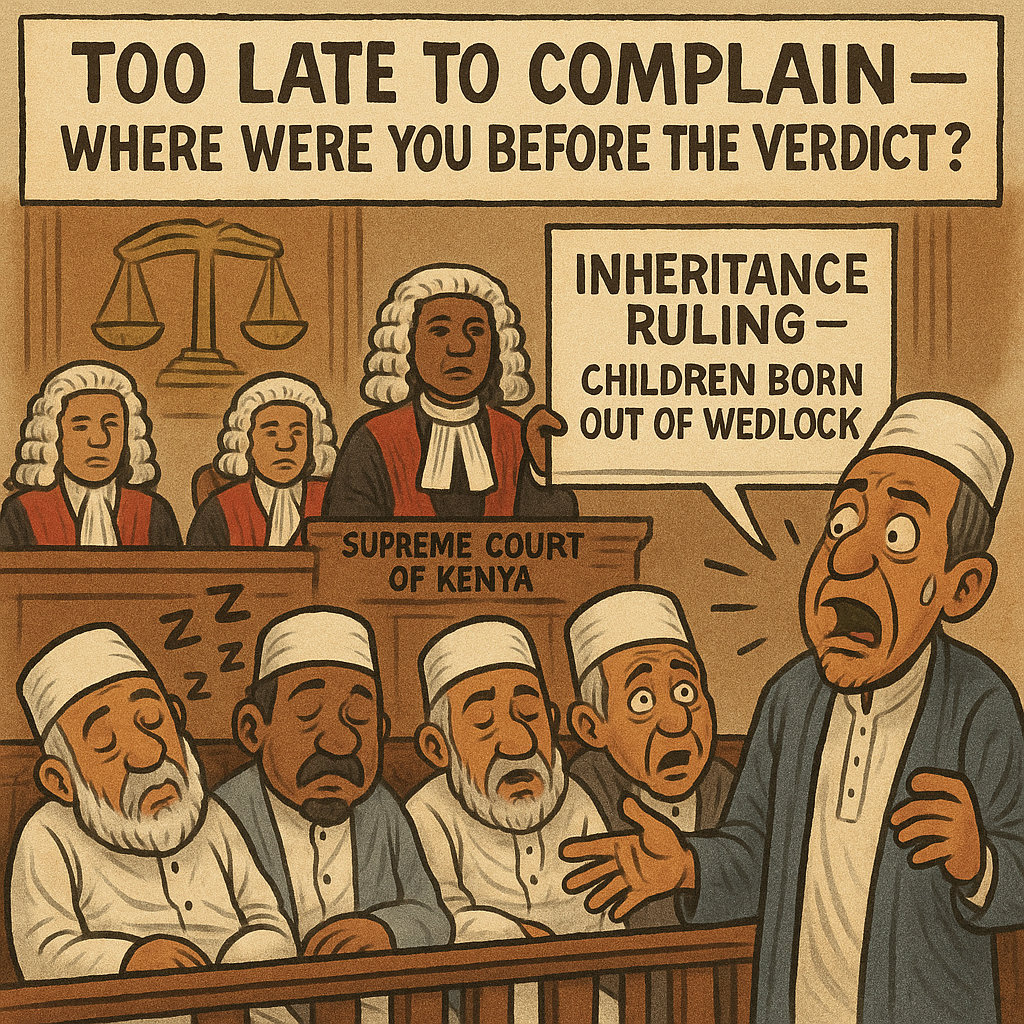

The Supreme Court of Kenya’s recent decision to allow children born out of wedlock to inherit from their Muslim fathers has stirred considerable debate. But while much of the conversation has centered around the themes of equality, inclusion, and constitutional rights, a deeper, more critical issue remains buried beneath the surface: Has the Court overstepped its bounds into the sacred domain of Islamic law?
Contrary to common misperception, Islam is not merely a religion—it is a comprehensive way of life..
governed by the Qur’an, the Hadith, and the Sunnah of Prophet Muhammad (SAW), Islam’s legal system—Shariah—operates as an integrated, divine framework. Its rulings on inheritance are not arbitrary or discriminatory, but rooted in a system of equity, not Western equality. The distinction matters. While the Kenyan constitution promotes formal equality, Islamic equity accounts for lineage, legitimacy, and social responsibility in ways that secular frameworks simply cannot capture.
The Court’s ruling, in attempting to align Islamic inheritance law with the Constitution’s anti-discrimination provisions, has effectively reviewed and revised the core of a faith-based legal system. This is not just judicial activism—it is a quiet but seismic re-engineering of Islamic legal doctrine by a secular institution.
And that, for many Muslims, is not just unacceptable—it is blasphemous.
To be clear: Islam’s position on inheritance for children born outside wedlock is not a matter of public opinion, progressive reinterpretation, or local cultural preference. It is a position founded on divine revelation and juristic consensus. A child born outside nikah (legal marriage) does not inherit from the father, not as punishment to the child, but as a reaffirmation of the sanctity of the marital institution in Islam. This ruling is not to be viewed in isolation—it is part of a larger, coherent system.
What is perhaps even more troubling is the deafening silence of Muslim leaders and religious institutions in the lead-up to this ruling. The case did not spring from nowhere. It traversed the High Court, the Court of Appeal, and finally the Supreme Court. At every stage, there was opportunity—indeed a duty—for Kenya’s Muslim leadership to step in, be enjoined, and represent the Islamic position as amicus curiae or interveners.
Instead, what we witnessed was reaction without preparation, condemnation without participation. The National Muslim Leaders Forum (NAMLEF), the Supreme Council of Kenya Muslims (SUPKEM), and other prominent Islamic institutions only began to voice their outrage after the ruling was made. Where were they when it mattered? Is this a case of neglect, or worse, a perception that religious issues are the burden of individuals until they explode into communal crises?
This leadership vacuum has now left ordinary Muslims to bear the brunt of a ruling they neither expected nor consented to. It raises uncomfortable but necessary questions: Have we delegated too much of our religious responsibility to institutions that act only after the damage is done? Or is there a deeper malaise—a reluctance to confront modern legal challenges with robust Islamic scholarship and strategy?
Some may argue that constitutional supremacy leaves no room for religious exception. But that is a narrow view. Kenya’s constitution recognizes freedom of religion and respects personal laws under Article 24.
The Kadhi’s Courts exist precisely because the secular system acknowledges that Muslims have a distinct legal identity.
The Supreme Court’s ruling blurs this line and threatens the viability of that parallel jurisdiction.
In the end, this is more than just a legal debate—it’s a moment of reckoning. If Muslim leaders don’t mobilize legally, socially, and intellectually to protect the integrity of Islamic practice, then secular structures will define it for them.
The Supreme Court may have ruled, but the Muslim community must now lead—not from the rear, but from the frontlines.