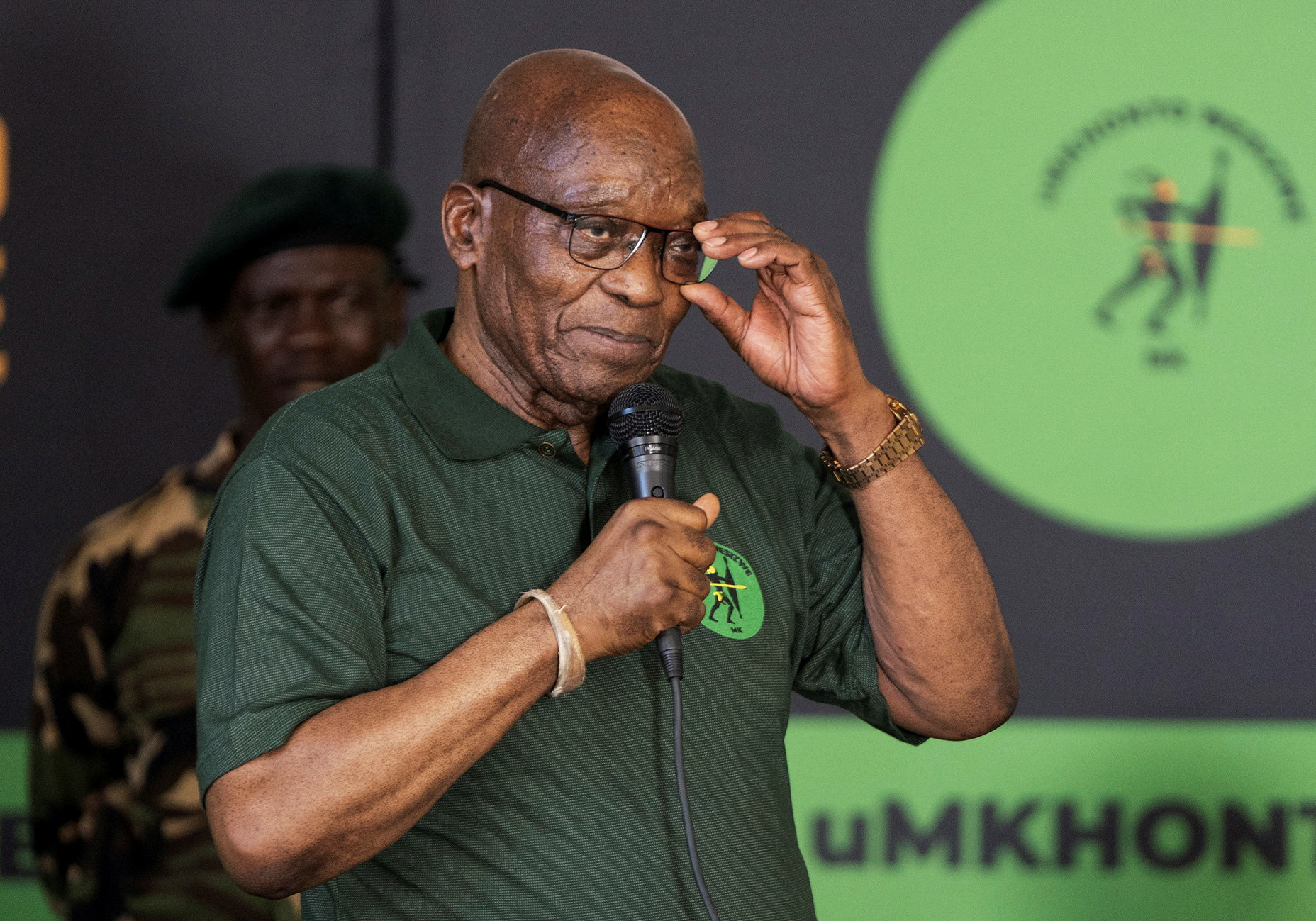
Jacob Zuma’s political charisma has long clouded people`s objective assessments of his leadership. Undoubtedly, Zuma is a shrewd political tactician. His strategic manoeuvring has helped him survive political storms that would have destroyed many. Yet beyond the charm and his image as a man of the people lies a sobering reality. Zuma offers little in terms of ideological depth or meaningful policy reform.
His politics are rooted more in patronage than progress, more in populism than principle.
This shallowness is most evident in the calibre of political figures and movements that align themselves with him. Many are regressive, opportunistic, and self-serving echo chambers rather than challengers of his thought. Their loyalty lies not with the people, but with the preservation of a network sustained by proximity to power. Zuma’s legacy is entangled with a parasitic patronage system that cannibalised state resources and crippled meaningful entrepreneurial development.
One of the most persistent myths surrounding his presidency is that he was the architect of South Africa’s black middle class or even the creator of a new generation of black millionaires. But scientific data and independent research challenge this claim with cold clarity. According to Statistics South Africa (2022), black African households experienced a marginal increase in income from R60,613 in 2006 to R92,983 in 2015 a rise that is largely attributable to inflation and social grants, not wealth creation through industry or enterprise. The National Income Dynamics Study (NIDS) Wave 5 (2017) further revealed that wealth inequality among black South Africans remained alarmingly high, with the top 10% holding over 90% of the wealth.
Zuma’s legacy is entangled with a parasitic patronage system that cannibalised state resources and crippled meaningful entrepreneurial development.
Many of the so called beneficiaries of economic emancipation under Zuma’s administration were, in reality members of elite networks often linked to state capture mechanisms. Forums like Amadela ngokubona and Gupta nexus flourished, providing lucrative contracts to politically connected individuals while excluding genuine, grassroots entrepreneurs. The result? A distorted economy where merit took a backseat to connection, and innovation was strangled by corruption.
Zuma’s political allies, including those currently coalescing under the MKP (uMkhonto weSizwe Party), have positioned themselves as a leftist alternative. But their rhetoric rings hollow. The MKP, which had a unique opportunity to emerge as a transformative political force for the marginalised, has instead squandered it. From the onset, the party has suffered from internal contradictions, factionalism, and a complete lack of ideological clarity.
Their public discourse is muddled and reactionary, marked more by nostalgia than vision.
The recent removal of Floyd Nyiko Shivambu one of the few voices with intellectual ragout has delivered a staggering blow to their credibility. Rather than galvanising a grassroots movement grounded in progressive leftist ideals, the MKP has regressed into a chaotic shell, drifting further from relevance. This regression coincides with critical national crises rampant water insecurity, business mafias, and institutional decay many of which gained traction under Zuma’s administration and were never decisively addressed.
KwaZulu-Natal, in particular, finds itself at a political crossroads. The province has been plagued by a brand of tribalistic populism that thrives on personality cults rather than policy. Zuma’s continued influence risks entrenching this dangerous tendency. The time has come to shed the politics of tribal loyalty and patronage, and to demand leadership rooted in substance, vision, and integrity.
This entire political debacle is not just a lesson in failed leadership, it is an opportunity for introspection. South Africa must move beyond the illusion of liberators. Real economic freedom is built on productivity, innovation, and equity not on the shadow of a patron’s favour. Let us not be seduced by charisma again. The stakes are far too high.
——————————————-
Mr. Nbabenhle Mthembu is a columnist for Observer Witness, a political scientist, practicing journalist and a professional lecturer in Journalism, Media and Public Relations.