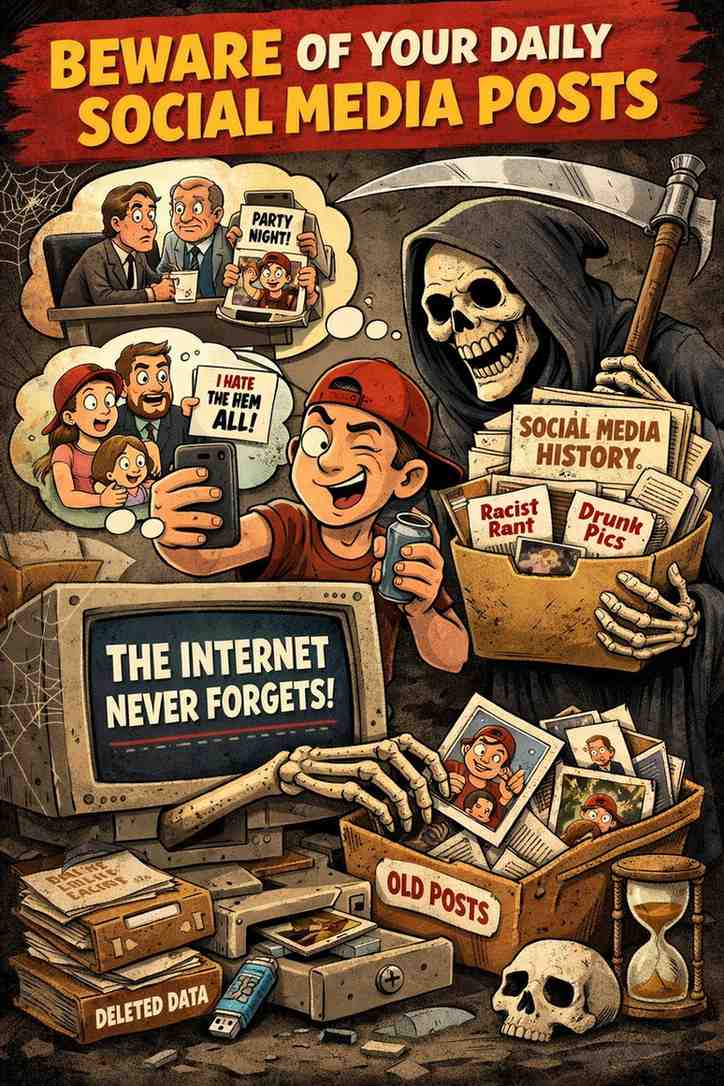
There was a time when a careless comment faded with the conversation, when a bad decision lived only in memory, and when growing up meant being allowed to change quietly. Social media has altered that reality entirely. Platforms such as TikTok, WhatsApp, Instagram, Threads, Facebook, X, and YouTube have turned everyday users into constant broadcasters, publishing thoughts, images, jokes, anger, and vulnerability without editors, filters, or pause. What feels fleeting in the moment is, in fact, remarkably loing-lasting.
We post casually, often emotionally, and sometimes recklessly. We share our best moments and our worst instincts side by side. In doing so, we reveal more than we intend, not just where we are or what we think, but who we are becoming. Social media has become a public diary written in ink, not pencil. And unlike face-to-face interactions, there is no rewind, no quiet apology, no guarantee that context will be remembered.
Our Daily Social Media Posts Reveal Our Inner Selves
At its best, this openness can be powerful. Social media has amplified voices that were once ignored. It has helped people find community, express creativity, challenge injustice, and tell stories that matter. But it has also become a space where racism, sexism, ethnocentrism, cruelty, and self-indulgence are aired with startling ease. Many people say online what they would never say aloud. Others post images they would never show their parents, their future children, or their employers.
The uncomfortable truth is that our digital lives expose our inner selves—sometimes the thoughtful parts, sometimes the darker ones. A sarcastic joke may carry prejudice. A heated comment may reveal contempt. A viral rant may document a moment of anger that no longer reflects who we are. Yet the platform does not know the difference between who we were then and who we are now. It records everything equally.
Others post images they would never show their parents, their future children, or their employers.
Time, however, changes everything. Today’s social media users are tomorrow’s parents, spouses, in-laws, managers, CEOs, pastors, teachers, and community leaders. The carefree teenager becomes a job applicant. The outspoken student becomes a professional. The anonymous commenter becomes someone expected to lead, mentor, or inspire. And when that time comes, the past often resurfaces uninvited.
Imagine sitting across from a potential employer while old posts of comments or pictures, videos circulate in the background, or of tweets mocking a race, comments attacking a community, videos glorifying nudity, theft or any harmful behaviour. What do you say then? That you have changed? That you were young? That you no longer hold those views? Sometimes that is true. But the digital record offers no footnotes, no explanations, no evidence of growth unless it, too, has been documented.
The same tension applies to personal life. How does one explain to a partner, an in-law, or a faith community that those words no longer represent them? Trust is fragile, and once shaken, it is difficult to rebuild. Screenshots, unlike memories, do not soften with time. They wait.
This is not about moral panic or advocating silence. It is about awareness. The internet does not operate like human relationships do. It does not forget, forgive, or contextualise. It stores. It resurfaces. It connects past behaviour to present opportunity. In an age where employers, institutions, and communities increasingly assess character through digital footprints, social media has become an informal but powerful background check.
But the digital record offers no footnotes, no explanations, no evidence of growth or change
Every post, in that sense, is a seed. Some grow into opportunities—networks, careers, influence, and respect. Others grow into obstacles, missed jobs, broken relationships, lost credibility. The challenge is that the harvest does not come immediately. It comes later, when the stakes are higher and the margin for explanation is smaller.
What many users underestimate is how quickly private expression becomes public evidence. A WhatsApp screenshot escapes a closed group. A deleted post lives on in someone else’s archive. A joke meant for friends travels far beyond its intended audience. The idea that content can be controlled once released is largely an illusion.
Growing up has always involved mistakes. What is new is that those mistakes now come with permanent documentation. This reality calls for a different kind of maturity, not perfection, but responsibility. Not self-censorship, but foresight. The question is no longer just “How do I feel right now?” but “How will this represent me later?”
Perhaps the most important question of all is a simple one: when the future comes looking for you, what will it find? A record of growth, empathy, and accountability—or a trail of words and images you wish had been left behind?
The internet is watching quietly, storing patiently. The harvest will come. The only uncertainty is whether we will be proud of what we planted.