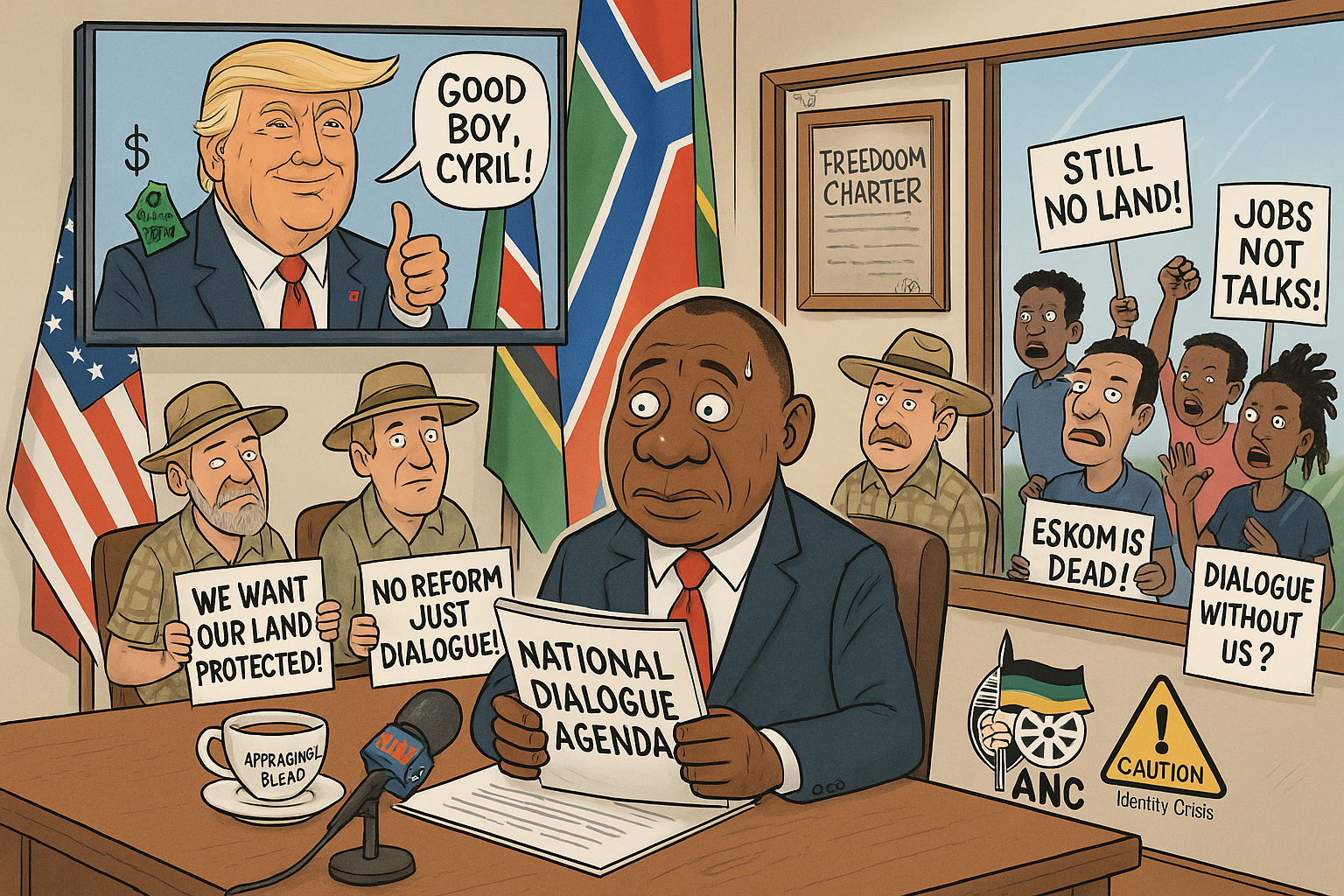
President Cyril Ramaphosa has once again stood before the nation with polished speeches and grand visions, this time calling for a “national dialogue” on the future of South Africa. It sounds noble. It sounds necessary. But strip away the diplomatic polish and you are left with a deeply uncomfortable question: Is this dialogue really for South Africa, or is it a strategic smokescreen to appease global power brokers and white conservative interests?
But strip away the diplomatic polish and you are left with a deeply uncomfortable question
Let’s start with what we already know, and what has been known for decades. South Africa is still a deeply unequal society. According to the World Bank, it remains one of the most unequal countries in the world. The land remains largely in the hands of a white minority. Black South Africans, the majority, still largely live on the economic periphery, excluded from wealth creation, stuck in generational poverty, and held hostage by an economy that never structurally transformed after 1994.
Yet, instead of confronting these injustices head-on, Ramaphosa’s administration appears more concerned with cosmetic reconciliation than radical economic redress. The idea of a national dialogue is being sold as a unifying force, but beneath its surface lies a crisis of credibility and intention. Why now? Why this way? Why under the glossy label of inclusivity, when inclusion still excludes the very people who fought for freedom?
Why under the glossy label of inclusivity, when inclusion still excludes the very people who fought for freedom?
The African National Congress (ANC), once the custodian of the people’s hopes, is no longer marching to the rhythm of the Freedom Charter. “The people shall share in the country’s wealth,” it boldly proclaimed. Yet today, under ANC governance, the people, especially Black South Africans, are spectators to the banquet of the elite. Instead of transformation, we see tokenism. Instead of land redistribution, we see land panels and endless consultations.
Worse still, the government’s plan to revise BEE (Black Economic Empowerment) in the name of inclusivity within the so-called Government of National Unity (GNU) sends a deeply confusing and potentially dangerous signal. Inclusivity without transformation is just assimilation. You cannot water down economic redress to accommodate the very structures that maintain inequality and then call that justice. The face of this GNU is starting to look eerily similar to the post-apartheid compromise that delayed real change under the illusion of peace.
There are also geopolitical undertones that cannot be ignored. President Ramaphosa’s national dialogue arrives just as diplomatic tensions with the United States have heightened, particularly around South Africa’s non-aligned stance on global conflicts and its lukewarm response to Western pressure on land reform and property rights. The sudden call for unity, coupled with inclusive policy rhetoric, looks suspiciously like an olive branch to white extremist farmers, foreign investors, and even the Trump administration, which has repeatedly raised concerns about land expropriation and “white genocide” myths.
Is this dialogue a way to assure Washington and Brussels that South Africa is still “open for business”? Is Ramaphosa trying to calm the markets and Western fears by sacrificing bold policy for soft diplomacy?
This is not to dismiss dialogue altogether, South Africa indeed needs a national conversation. But it must be a dialogue rooted in truth, justice, and redistribution, not a performative exercise to sanitize political optics.
Black south africans need dialogue that confronts land injustice, dismantles economic apartheid, and reclaims the ANC’s forgotten promises. Anything less is betrayal.
The real tragedy is that ordinary South Africans continue to wait at the gate while the national cake is sliced behind closed doors. They are invited to the “dialogue” but not to the deal-making. The black youth remain unemployed. The landless remain landless. The promise of transformation has become the prison of patience.
President Ramaphosa must be asked, firmly and publicly: Whose dialogue is this? Who benefits from it? And why should we trust it? Until those questions are answered honestly, the national dialogue will remain exactly what many suspect it is, a clever performance staged for foreign cameras, investors, and a political class desperate to maintain control.
If the ANC truly wants to restore its legacy, it must stop talking and start acting. The time for dialogues is over. The time for economic justice is now.