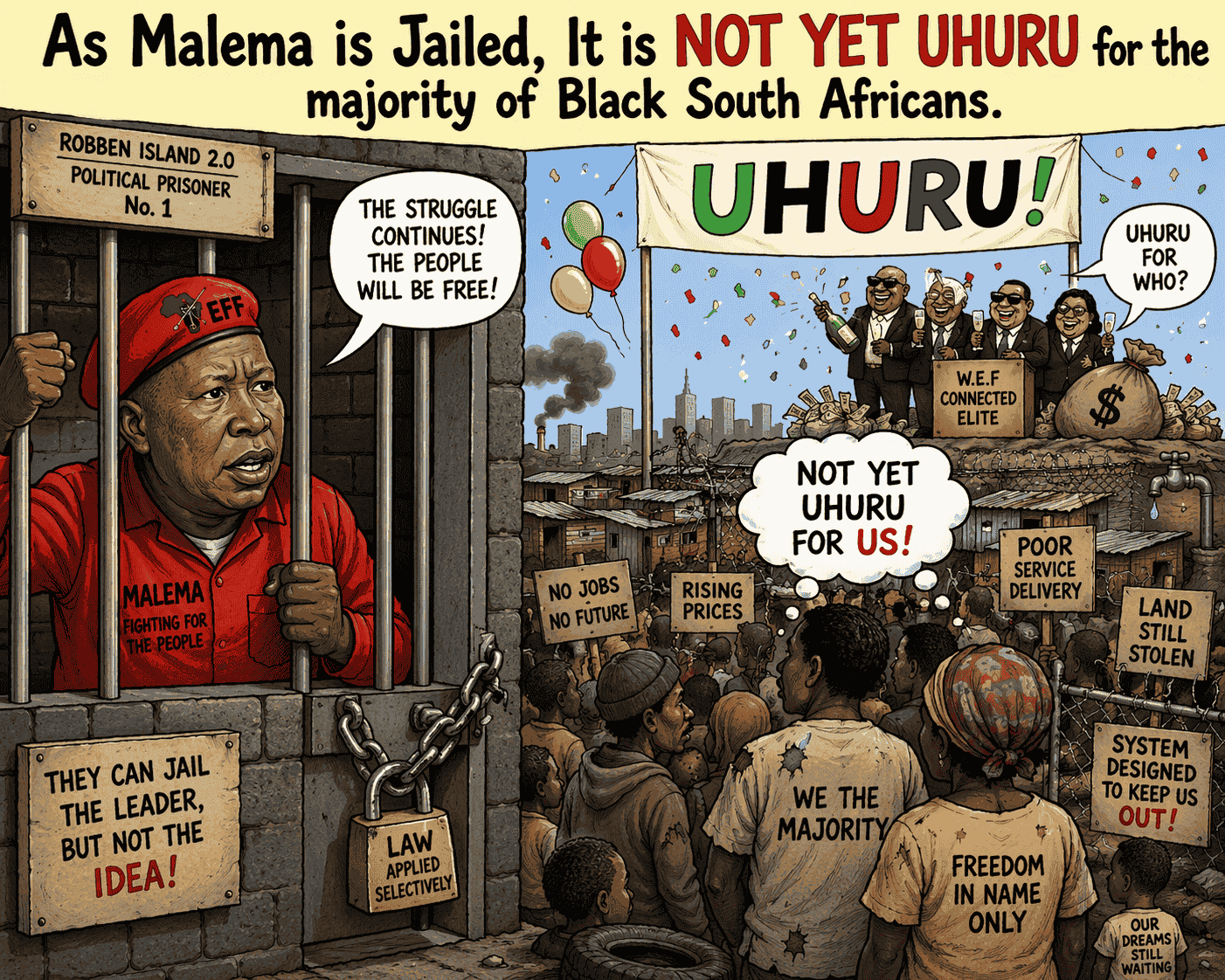
The transition to democracy in South Africa in 1994 marked a decisive rupture with formal apartheid rule. Political rights were extended, institutions were reconstituted, and constitutionalism was entrenched. Yet, three decades later, the distribution of economic power, productive assets, and institutional influence remains structurally skewed. The central claim is difficult to avoid: NOT YET UHURU for the majority of Black South Africans.
Empirical indicators support this position. South Africa remains one of the most unequal societies globally, with a persistently high Gini coefficient. Wealth concentration is acute. Estimates by the World Inequality Database and related studies suggest that the top decile controls a disproportionate share of national wealth, while the bottom half holds a negligible fraction. Land ownership patterns, despite reform efforts, still reflect apartheid-era dispossession, with a minority controlling most commercial farmland. Unemployment, particularly among Black youth, exceeds 40% on the expanded definition. These are not transitional anomalies; they are structural outcomes.
South Africa remains one of the most unequal societies globally
The democratic state has, in formal terms, expanded access to social grants, education, and housing. These interventions have mitigated extreme poverty but have not fundamentally altered ownership patterns in key sectors. Capital-intensive industries, financial services, and property markets remain dominated by historically advantaged groups. Even where Black participation has increased through policies such as Broad-Based Black Economic Empowerment (B-BBEE), gains are often concentrated among a narrow elite. This has produced what may be termed a “buffer class”: a Black middle stratum with access to consumption but limited control over productive capital.
The persistence of inequality is reinforced by institutional continuity. The judiciary, corporate law firms, accounting networks, asset management firms, and higher education institutions display slow rates of transformation at senior levels. While formal barriers have been removed, informal networks, credential pipelines, and capital requirements reproduce exclusion. In the property and investment sectors, entry thresholds remain prohibitive. In agriculture, access to land, finance, and markets constrains emerging Black farmers. The result is a dual economy: a capital-rich enclave integrated into global markets, and a labour-surplus majority with precarious livelihoods.
Unemployment, particularly among Black youth, exceeds 40% on the expanded definition.
Political participation has not translated into economic sovereignty. Electoral democracy confers voice, but not necessarily control over accumulation processes. The state’s macroeconomic policy orientation since the mid-1990s prioritised fiscal consolidation, inflation targeting, and openness to global capital. While these choices stabilised key indicators, they also limited the scope for redistributive industrial policy. Deindustrialisation in certain sectors, coupled with skills mismatches, has deepened labour market exclusion.
Public service delivery failures further erode the material basis of citizenship. Load shedding, municipal dysfunction, and infrastructure decay disproportionately affect low-income communities. Education outcomes remain stratified: historically advantaged schools and universities continue to outperform under-resourced counterparts, reproducing intergenerational inequality. Health system disparities mirror this pattern. These are not isolated governance lapses; they interact with structural inequality to sustain deprivation.
The social psychology of inequality also matters. The emergence of a Black middle class has, in some cases, been accompanied by aspirational consumption without corresponding asset accumulation. Access to credit enables visible mobility, yet debt burdens and job insecurity limit long-term wealth formation. This creates a perception gap between status and security. Meanwhile, the majority, those queuing early on election days, exercise political rights in conditions of economic vulnerability, with limited evidence that electoral cycles materially shift their prospects.
There is limited evidence that electoral cycles materially shift their prospects.
Within this context, radical critiques of the post-apartheid settlement have gained traction. Figures such as Julius Malema and the Economic Freedom Fighters (EFF) articulate a program centred on land expropriation without compensation, nationalisation of key sectors, and state-led redistribution. Their argument is that political liberation without economic transformation entrenches inequality. Whether one agrees with their policy prescriptions or not, their appeal reflects a real constituency: those for whom democracy has not delivered substantive change.
Claims that such voices are being “silenced” require careful qualification. South Africa retains a robust constitutional order with protections for speech and opposition. The EFF operates openly, participates in elections, and holds parliamentary seats. However, there are constraints that shape political competition: campaign financing disparities, media framing, and legal challenges can influence the visibility and viability of radical platforms. Additionally, internal party dynamics and leadership controversies complicate the narrative of suppression. A rigorous critique distinguishes between structural barriers to political influence and outright silencing.
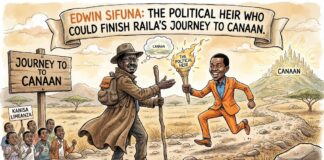
The metaphor of “Canaan” captures a deeper expectation: that liberation should culminate in material security, dignity, and control over one’s economic life. On these metrics, progress is uneven and insufficient. Land reform has been slow and, at times, administratively ineffective. Industrial policy has not generated labour-absorbing growth at scale. Small and medium enterprise development faces credit and regulatory hurdles. Corruption and state capture episodes have diverted resources and undermined capacity.
liberation should culminate in material security, dignity, and control over one’s economic life
A credible path forward requires confronting ownership patterns directly while maintaining institutional integrity. This includes accelerating land reform with clear tenure security, expanding access to finance for Black entrepreneurs, reforming procurement to support productive enterprises rather than rent-seeking, and investing in skills aligned to industrial strategy. It also requires improving state capability at municipal and national levels. Redistribution without growth is unsustainable; growth without redistribution is exclusionary.
In sum, South Africa’s democratic project achieved formal equality but has not delivered substantive economic justice for the majority. The coexistence of political rights with entrenched inequality sustains the conclusion: NOT YET UHURU. The task is not to discard democracy, but to deepen it, by aligning political inclusion with economic transformation.
The writer, Dr. Tiema Haji is an academic, researcher, author, journalist, communication specialist and an accomplished poet.