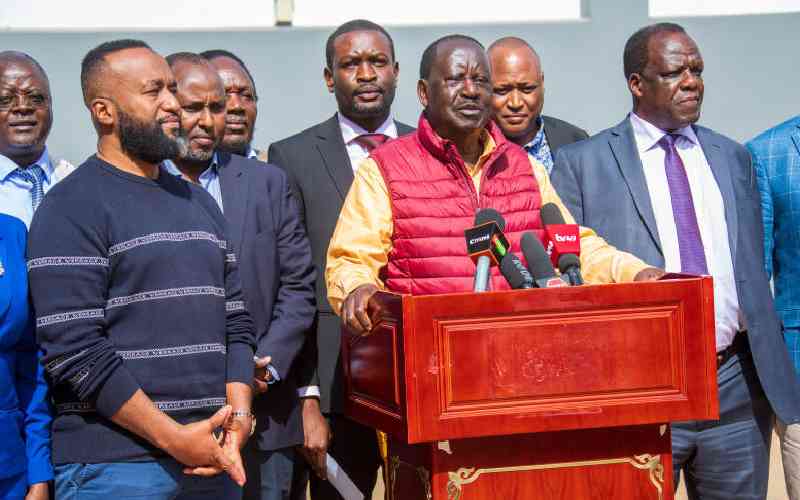

Raila Odinga, Kenya’s longest-serving opposition figure and the face of the Orange Democratic Movement (ODM), defined an era. As Prime Minister in 2008 and five-time presidential candidate, his influence extended far beyond electoral politics. With his death, ODM loses not only its leader but its central organising principle. For decades, ODM functioned less as an institutional party and more as Raila’s movement, bound together by loyalty rather than internal democracy (People Daily Insights, 2025).
The challenge now: can ODM evolve into a durable institution?
Following Raila’s passing, the ODM National Executive Committee appointed Oburu Oginga, Raila’s elder brother and Siaya Senator, as Acting Party Leader, a symbolic choice meant to anchor continuity (Nation, 2025). However, deep fissures are emerging. One camp, led by Wycliffe Oparanya and Edwin Sifuna, advocates institutional reform, stronger structures, transparent nominations, and even fielding a presidential candidate in 2027. Another faction, aligned with Opiyo Wandayi and the so-called “handshake coalition,” wants ODM to maintain its partnership with President Ruto, arguing that Raila’s final cooperation with the government provides a moral and political precedent.
The camps reflect contrasting motivations: the reformists want ideological renewal and generational inclusion, while the coalitionists prioritise access to state resources and political survival. Without Raila’s personal authority to mediate disputes, these interests could clash openly.
ODM camps reflect contrasting motivations
The Three Scenarios
- Institutional Rebirth, ODM reforms its structures, holds a National Delegates Convention, and elects substantive leadership. The party rebrands and retains its dominance in Nyanza and Coast. Winners: younger leaders and reformists.
- Fragmentation and Defections, Without Raila’s pull, regional politicians join rival parties or new alliances. ODM loses cohesion and identity.
- Junior Coalition Partner, ODM trades opposition status for ministerial roles, becoming a secondary partner to the ruling coalition. Short-term gain, long-term identity erosion.
Political science theories provide useful insights. Party institutionalisation theory (Randall & Svåsand) warns that personalist parties rarely survive their founders unless they evolve organisationally. Clientelism theory explains ODM’s enduring power in terms of patronage, politicians remain loyal where resource flows continue. Yet coalition theory (Laver & Schofield, 1990) reminds us that junior partners often lose autonomy, even when they retain access.
ODM stands at a crossroads: evolve into an institution, or decay into factions
In short, ODM stands at a crossroads: evolve into an institution, or decay into factions. At the grassroots, MPs and governors in Nyanza and Coast must decide: loyalty to ODM’s legacy, or pragmatism for survival? History suggests defections will follow resource flows. If the party reforms its nomination system and enhances transparency, loyalty may endure. If not, ODM risks slow erosion—one constituency at a time.