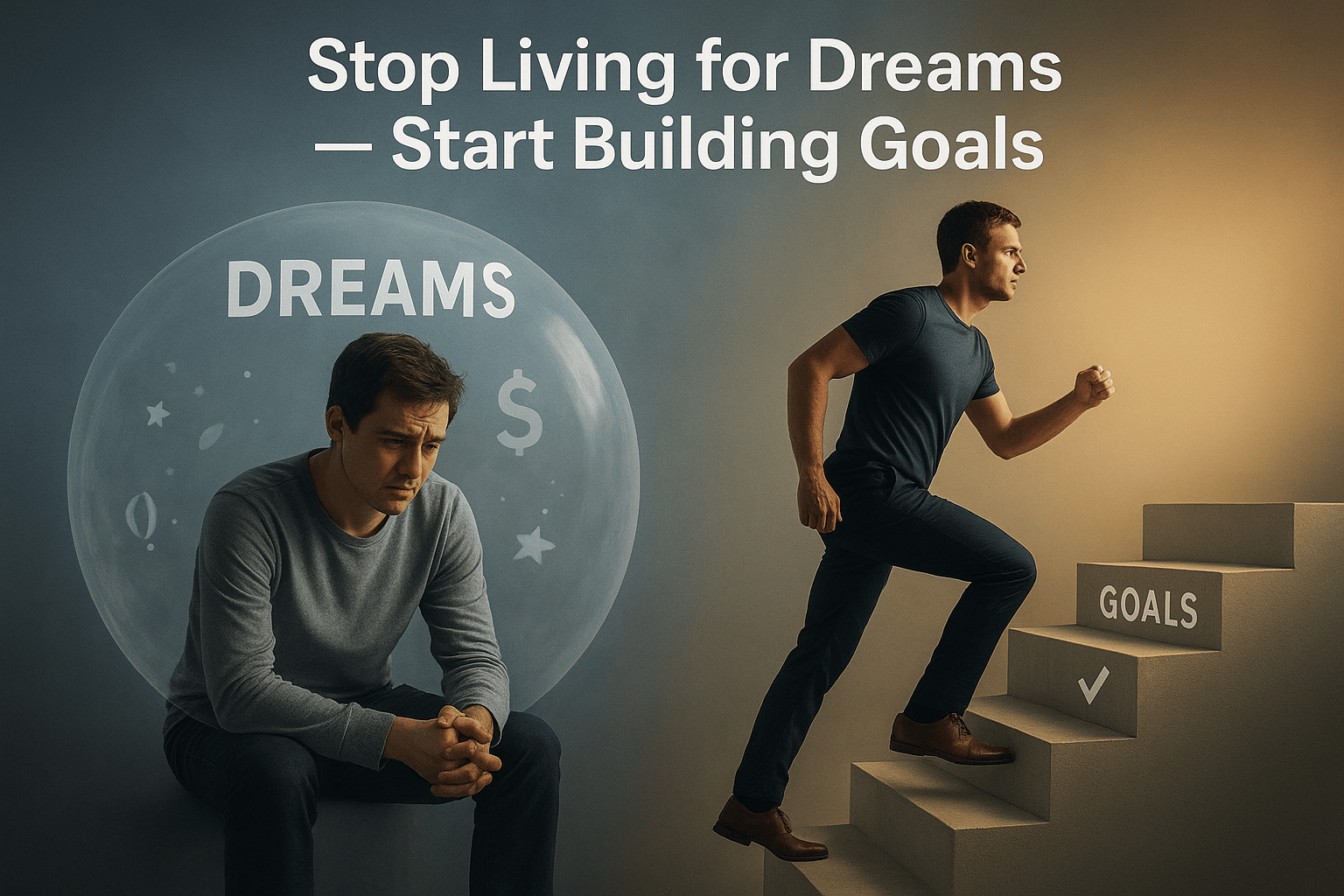

Every day, millions of people wake up with dreams in their hearts but no plan in their hands. They picture a future filled with success, recognition, or freedom but remain trapped in their current routines. These visions can be exhilarating, but they’re also dangerous when left unchecked. Dreams, when unanchored, are mirages, inspiring to look at but impossible to grasp. Goals, on the other hand, are blueprints. They’re concrete, measurable, and achievable. If dreams are the stars, goals are the steps of the ladder reaching toward them.
Dreams Are Fantasies, Goals Are Frameworks
A dream is a wish, something you hope for but cannot fully define. “I want to be rich.” “I want to be famous.” “I want to change the world.” These are beautiful aspirations, but they’re fog without form. By contrast, a goal is a decision. It’s the difference between saying, “I want to be healthy” and “I will run three times a week and cut sugar from my diet for the next 90 days.” One is vague; the other is actionable.
Psychologist Edwin Locke’s Goal-Setting Theory demonstrates that specific, challenging goals increase performance far more than vague aspirations. In other words, your brain responds to clear targets. When you translate a dream into a structured plan, your mind knows how to allocate attention, energy, and resources.
Why People Stay Helpless Waiting for Dreams
Many people live passively, waiting for a break, a miracle, or a stroke of luck. They confuse envisioning with acting. This “someday” mentality breeds frustration and helplessness. BehavioUral psychologists call this learned helplessness, the state where individuals stop trying because they believe outcomes are beyond their control. When dreams remain unstructured, they reinforce that helplessness.
Social media intensifies the illusion. We scroll through curated images of others “living the dream” and imagine success as something instant and magical. But the truth is, even the most celebrated success stories are built on deliberate goals and relentless follow-through, not daydreams.
Why Some People Achieve
Conversely, high achievers translate dreams into clear goals and systems. They practice implementation intentions: “If situation X occurs, I will do Y.” This technique, rooted in psychology, dramatically increases the likelihood of following through. Instead of “I’ll write a book someday,” they commit to “I will write 500 words every morning before work.”
Research on self-efficacy (Bandura, 2012) shows that believing in your ability to achieve a goal strengthens motivation and persistence. Setting goals builds that belief. Each small win becomes evidence that you’re capable, reshaping your identity from a dreamer into a doer.
The Psychological Toll of Dreams vs. Goals
Dreams without action can become a source of anxiety and self-criticism. The gap between where you are and where you fantasiSe to be can feel like a canyon you can’t cross. Goals, however, narrow that gap into measurable steps. The brain loves progress. Dopamine, the neurotransmitter linked to motivation, surges not only when we achieve something but when we anticipate achieving a clear target. This is why crossing off items on a to-do list feels so good; it’s a neurochemical reward for goal-directed action.
Shifting from Dreamer to Goal-Setter
How can you stop living for dreams and start achieving goals?
- Define the dream in measurable terms. If your dream is to “be financially free,” specify an amount and a deadline.
- Break it into milestones. Turn “run a marathon” into “train three times a week for 16 weeks.”
- Use time-bound commitments. Deadlines create urgency and accountability.
- Track and adjust. Regularly monitor your progress and recalibrate.
This approach transforms your dream from an illusion into a project plan. It also builds confidence. With each completed step, your self-image evolves into that of someone who follows through.
An Eye-Opening Takeaway
Dreams inspire, but goals deliver. People who live only for their dreams risk waiting endlessly, feeling powerless as life passes by. People who live for their goals, however, experience tangible progress, resilience, and empowerment. They turn “someday” into “today.”
The invitation is simple but profound: don’t discard your dreams, reshape them. Translate them into clear, measurable goals with deadlines and action steps. By doing so, you’ll step out of helpless hope and into purposeful progress.
At the end of your life, you won’t measure your worth by how much you dreamed but by how much you achieved and who you became in the process. So stop living for your dreams. Start building your goals. And watch how quickly your life shifts from fantasy to fulfilment.

The writer, Dr. Aba Appiah is a Ghanaian academic, researcher, and lecturer in her mid-20s with a professional focus on media and communication. Her career spans journalism and communication consultancy. As an accomplished author and researcher, she contributes to academic discourse through peer-reviewed studies and published works.