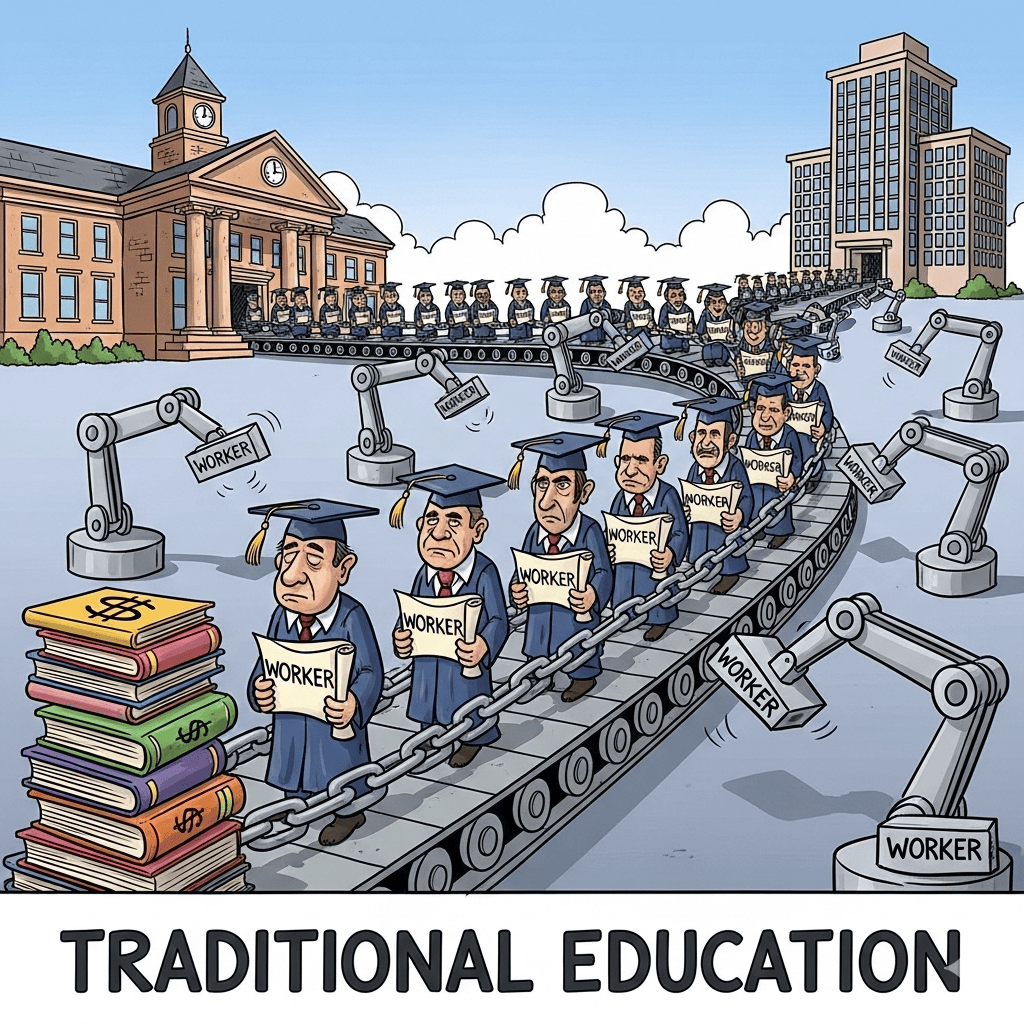

For more than a century, the education system in much of the world has operated like a conveyor belt. Children enter as blank slates, spend a dozen or more years absorbing approved knowledge, and then emerge with certificates to prove their “worthiness” to employers. This factory-style model, rooted in colonial-era schooling, was designed to produce compliant workers for government offices, factories, and companies, not bold innovators or risk-takers. In 2025, when youth unemployment in many countries is stubbornly high and entrepreneurship is celebrated as a driver of growth, the model no longer fits. It’s time to decolonise education.
This factory-style model, rooted in colonial-era schooling, was designed to produce compliant workers for government offices, factories,
The premise that formal qualifications are the only ticket to success has shaped entire generations. From the first day of school, young people are told implicitly and explicitly: study hard, get good grades, and you’ll land a stable job. Yet the reality is very different. The number of graduates far outpaces the number of secure, well-paying jobs. Universities and TVET colleges churn out thousands of degree holders every year, many of whom join long queues for limited vacancies. Meanwhile, small-business creation lags, innovation stagnates, and societies become dependent on a dwindling pool of employers. This is not an accident, it is the inevitable result of an education system designed to produce employees, not entrepreneurs.
A decolonised curriculum would not simply replace Shakespeare with African literature or Newton with indigenous science, though diversifying content is valuable. More fundamentally, it would challenge the assumption that learning exists primarily to secure employment. It would teach young people that knowledge is also a tool to build, innovate, and solve community problems. Imagine high schools where students learn business modelling alongside algebra, or universities where community co-ops and start-ups count as coursework. Instead of studying only to pass exams, students would graduate with a portfolio of tangible projects and entrepreneurial experience.
Unemployment is the inevitable result of an education system designed to produce employees, not entrepreneurs.
Another critical question is time. Why must a person spend 12 years in school before entering university? Who decided this timeline? In an age of instant access to information, online learning, and accelerated programs, it’s worth asking whether our schooling model could be shortened, intensified, or diversified. Many young people spend nearly 15 years in formal education before earning a degree. Could we reimagine this journey as seven or eight years of foundational learning followed by specialised pathways that mix apprenticeships, start-up incubation, and self-directed study? Such models already exist in pockets — coding bootcamps, competency-based universities, and skill accelerators — but mainstream schooling lags behind.
Critics may argue that decolonising education risks lowering standards or isolating countries from the global economy. Yet the opposite could be true. By producing confident, skilled entrepreneurs and adaptable workers, a decolonised system could reduce unemployment, stimulate innovation, and make economies more self-reliant. It could also bridge the gap between academic knowledge and practical life skills, ensuring graduates leave school with both theoretical understanding and real-world competence.
The broader social implications are profound. When education is designed around entrepreneurship and problem-solving, communities gain local solutions to local challenges—rather than waiting for imported answers. In Africa, for instance, a decolonised curriculum could foster agricultural innovation rooted in local conditions, renewable-energy ventures adapted to regional needs, or digital platforms that speak indigenous languages. These aren’t just “nice to haves”, they’re engines of economic sovereignty and dignity.
Of course, decolonisation does not mean abandoning rigour or international collaboration. A healthy education system blends global knowledge with local relevance. It trains students to think critically about all sources of information, whether Western or indigenous, and to choose what best serves their context.
In this sense, decolonising education is not about rejecting the world but about participating in it on fairer terms.
Ultimately, the goal is freedom: freedom for young people to imagine futures beyond the job market’s narrow corridors, freedom to create work rather than just seek it, and freedom for societies to define success on their own terms. An education system that channels every student into the same queue for employment is not only outdated but unjust. It traps human potential in a single mould and then blames graduates when jobs don’t materialise.
If we are serious about reducing unemployment and fostering innovation, we must stop treating degrees as passports to security and start seeing education as a platform for creativity, self-employment, and social transformation. We must decolonise our curricula so that a 21st-century learner can emerge after school not just as a qualified employee but as an empowered thinker, builder, and entrepreneur. Otherwise, we risk continuing the cycle of indoctrination — producing graduates trained to wait for opportunities instead of creating them.