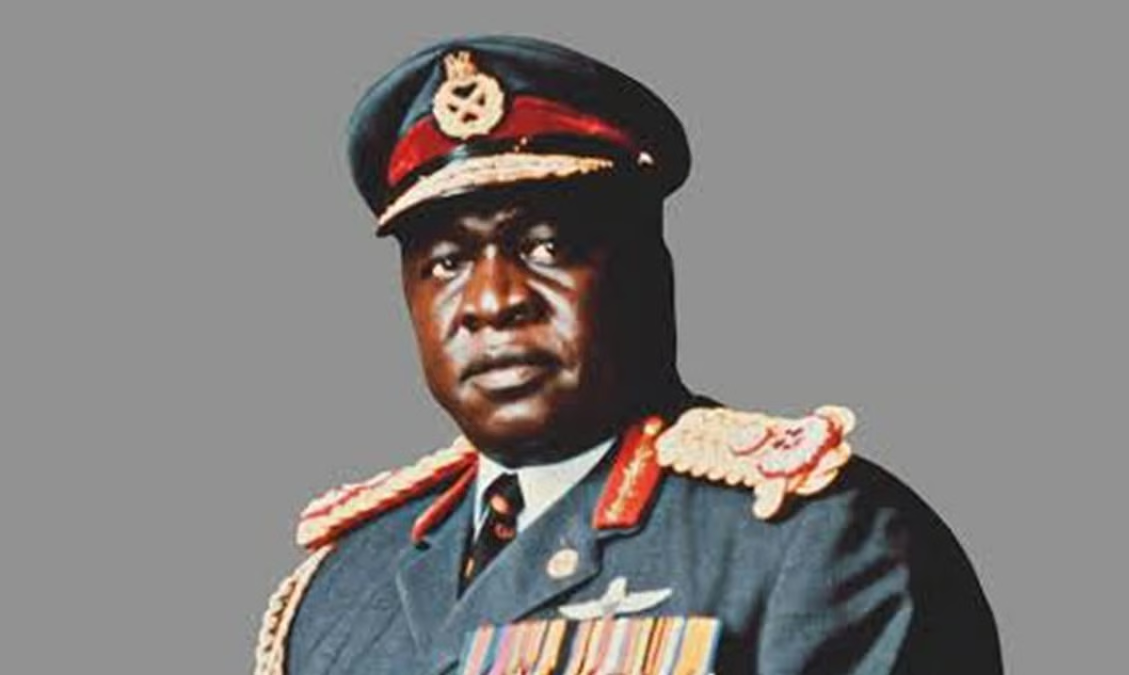

In the vast catalogue of African leaders vilified by Western media, few names evoke as much fea, and intrigue, as former Ugandan President Idi Amin Dada. Branded the “Butcher of Uganda,” accused of cannibalism, and routinely mocked as an illiterate brute, Amin has long been confined to the darker pages of history. Yet, as new generations revisit his legacy, especially through resurfaced video clips and firsthand accounts, a more nuanced, complex figure emerges.
Was he truly the caricature the West created, or a misunderstood nationalist who refused to bow to imperial pressures?
There’s no denying that President Amin’s rule from 1971 to 1979 was marked by state violence, political repression, and grave human rights violations. Estimates suggest more than 100,000 people lost their lives during his administration. These are serious charges, and they must not be ignored. But they should not be used to flatten his entire legacy.
Today, emerging video clips circulating across platforms like TikTok and X (formerly Twitter) reveal a side of Amin long concealed from public consciousness. In one 1975 interview with BBC journalist Brian Barron, Amin calmly and coherently explains Uganda’s position on African sovereignty, exposes the hypocrisy of Western democracies, and defends his economic nationalism.
Far from being incoherent, his delivery is sharp, reasoned, and infused with both wit and strategic clarity.
Another striking clip from an Organization of African Unity (OAU) summit shows the late president commanding the floor with gravitas, calling for greater continental unity and less dependence on former colonial powers. His language is deliberate, persuasive, and unmistakably Pan-African.
While it is true that President Amin had limited formal schooling, reportedly up to Standard 3, he possessed a remarkable political instinct and strategic intelligence that far exceeded many of his more “educated” contemporaries. His military background in the King’s African Rifles under the British colonial army, where he rose to the rank of major, speaks to his discipline, experience, and capacity for leadership.
One of the most controversial actions of his presidency, the 1972 expulsion of over 50,000 Asians from Uganda, has often been portrayed as senseless racism. But in his own words, as captured in archived footage, Amin describes the move as a push for economic decolonisation. He believed that national wealth should serve Ugandans first. Whether flawed or not, his decision was rooted in a desire to assert true sovereignty over Uganda’s economy, a theme that resonates today in discussions around neocolonialism.
Internationally, President Amin aligned himself with liberation movements across southern Africa, offered support to Palestinian and Arab causes, and challenged Western hegemony at a time when few African leaders dared to. His alliances with leaders like Libya’s Muammar Gaddafi and his bold, anti-imperialist rhetoric made him a target of Western hostility, and, by extension, their media machines.
Of course, Amin’s administration became increasingly authoritarian and violent. His reliance on fear and militarisation alienated both domestic and regional actors. Ultimately, in 1979, he was overthrown by a combined force of Ugandan exiles and the Tanzanian army.
He lived the rest of his life in exile in Saudi Arabia, passing away quietly in 2003.
Yet, in the age of digital reexamination, Amin’s legacy is being reconsidered. For many young Africans, he represents more than just tyranny, he symbolizes the complexity of postcolonial leadership and the dangers of single-story narratives crafted by distant powers.
President Idi Amin Dada was no saint. But he was also not the mindless brute portrayed in Western textbooks. He was a deeply flawed but fiercely independent Pan-Africanist, a nationalist who sought to defend his country’s dignity, even at immense personal and national cost. In revisiting his life, perhaps the true lesson is this: history must be written by those who lived it—not those who conquered it.